Bastrop, TX and nearby
AC repair in Bastrop, TX
An air conditioner that quits in Bastrop usually quits in the afternoon heat, and most of those failures are parts: a capacitor, a contactor, a fan motor, a clogged drain. The repair depends on which one, and a technician can usually say within the first half hour.
The line is answered 24/7. Calls may be recorded.
Why Bastrop air conditioners fail when they do
Normal highs at the Smithville weather station, the closest to Bastrop with full NOAA normals, sit above 90°F from June through September, and August averages 97°F. An outdoor unit that has been running since noon is at its hottest, its capacitor at its weakest and its compressor drawing the most current at about four o'clock. That is when a marginal part gives out.
Heat also exposes what spring hid. A system a little low on refrigerant cools well enough in May. By late June it runs all afternoon without reaching the setting, and by July the indoor coil may ice over.
What a technician checks, in order
- The thermostat and the breaker. Is the thermostat calling for cooling, and does the outdoor unit have power at the disconnect box beside it?
- Airflow. The filter, the return grille, and whether the indoor blower runs. A clogged filter can freeze a healthy coil.
- The outdoor electrical parts. The run capacitor, the contactor and the condenser fan motor. These are the most common failures here, and the quickest to replace.
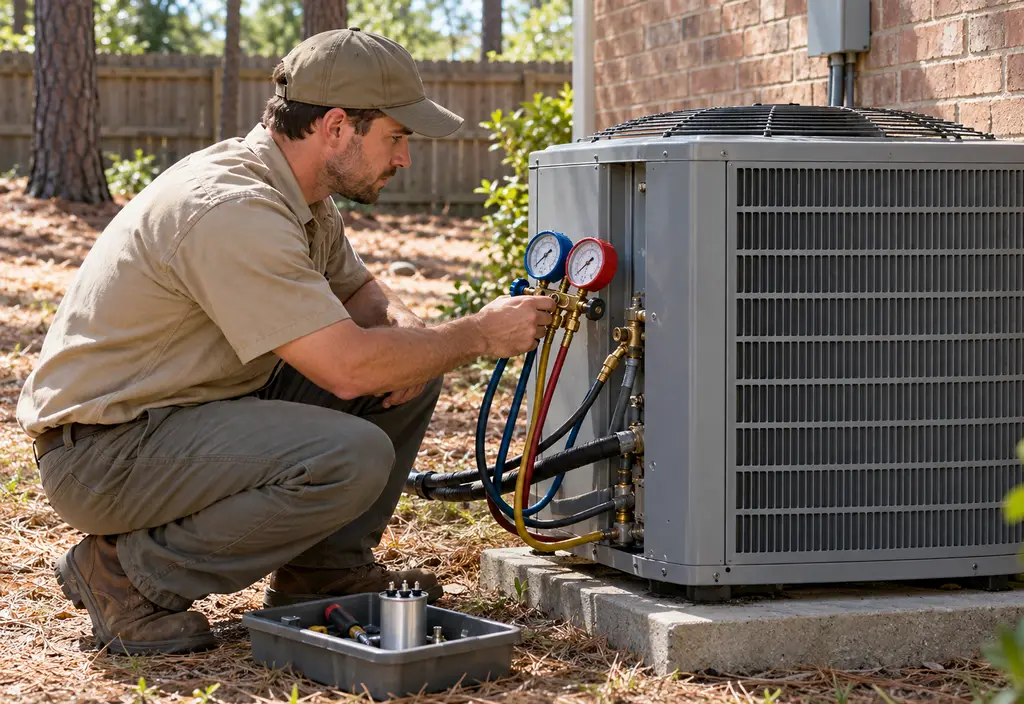
- Refrigerant pressures and the temperature split. Gauges on the service valves, and the difference between the air entering the return and the air leaving a vent. Together they separate a refrigerant problem from an airflow problem.
- The drain. In an attic install, the condensate line, the pan under the unit and the float switch that shuts the AC off when the pan fills.
Parts that are repairs, and failures that start a different talk
Usually a straightforward repair: capacitors, contactors, fan motors, a tripped float switch on a clogged drain, a loose wire at the disconnect, a failed thermostat.
Usually the start of a repair-or-replace discussion: a compressor that will not start, a leak in the indoor coil, or a system on R-22. R-22 has not been produced or imported since 2020, so a recharge means reclaimed refrigerant. A leak repair on a system past fifteen summers is worth comparing with AC replacement.
The visit and the repair are separate
The diagnostic visit finds the fault. The repair is agreed after that, with a figure in writing. Contractors set their own diagnostic charge, and many credit it toward the repair if the work goes ahead on the same visit. Ask about both before the visit is booked.
What to say when you call
- What the AC does: blows warm, runs nonstop, will not start, or the outdoor unit hums without the fan turning
- What the thermostat is set to and what the house reads
- The install year from the outdoor data plate, and the refrigerant printed on it
- Whether the indoor unit is in the attic, a closet or the garage
- Your ZIP code and how to reach the outdoor unit
Common questions
The fan outside is not spinning but something hums. Can I keep running it? Turn the system off at the thermostat. A compressor trying to start without the fan, or against a failed capacitor, overheats quickly. See the outdoor unit hums.
Ice on the copper line by the outdoor unit? Switch the AC off and the fan to "on" so the coil thaws, then call. Ice means either low airflow or low refrigerant; the frozen line page explains the difference.
Can it just be topped up with refrigerant? Refrigerant is not used up. A system that needs more has a leak, and a top-up without a leak search brings the same call back next summer.
Know the symptom and the install year? That is enough to start. Ask whether a contractor is taking calls in your ZIP code today.
(888) 217-3739